

Spelling mistakes may seem minor, but they can have a major impact on how your writing is perceived. In professional, academic, and online communication, even a single incorrect word can reduce your credibility and make your message appear less reliable. One of the most common spelling errors people make is confusing persue with pursue. At a glance, both versions may look correct, which is why this mistake frequently appears in resumes, emails, blog posts, and formal documents.
However, only one spelling is accepted in standard English—and the difference matters more than you might think. In this guide, you’ll learn the correct spelling, meaning, usage, and simple tricks to avoid this error forever. By the end, you’ll be able to use pursue confidently in any context and eliminate confusion once and for all.
The Correct Spelling: Pursue ✅
Let’s establish the foundation.
- Correct spelling: pursue
- Incorrect spelling: persue ❌
- Part of speech: Verb
- Pronunciation: /pərˈsuː/
- Base form: pursue
- Past tense: pursued
- Present participle: pursuing
- Noun form: pursuit
- Related words: pursuer, pursuing, pursued
If you ever find yourself typing persue, pause and correct it. The spelling has never been accepted in standard English.
What Does “Pursue” Mean?
The verb pursue means to follow something with determination or effort. Depending on context, it can describe physical action, long-term goals, or continued effort.
Core Definition
To pursue means to follow, chase, continue, or seek to achieve something with focus and intent.
Simple Examples
- She decided to pursue a degree in psychology.
- The police pursued the suspect through the city.
- He is pursuing his dream of becoming a pilot.
In modern English, pursue is used far more often in figurative ways than literal ones.
Why “Persue” Is Always Wrong 🚫
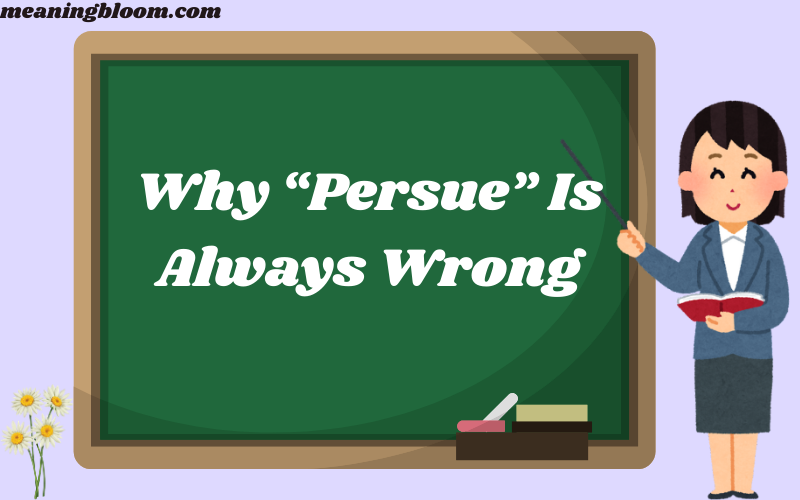
Many spelling mistakes happen because a word looks right. Persue feels natural to some writers because English contains many words that start with per-, such as perform, perfect, and permit. But that similarity is misleading.
Important Facts
- Persue is not listed in any major dictionary.
- It has no historical usage in standard English.
- It does not appear in academic, legal, or professional style guides.
- Spell-checkers and grammar tools flag it as incorrect.
Quick Comparison
| Word | Status | Meaning |
| Pursue | ✅ Correct | To chase, follow, or seek |
| Persue | ❌ Incorrect | Not a real English word |
If you see persue anywhere, it is always a spelling error.
Meaning and Usage of “Pursue” in English
The word pursue carries slightly different meanings depending on context. Below are the three most common uses.
1. Physical Chase or Following
Used to describe movement toward someone or something.
Example:
- The security guards pursued the thief through the mall.
2. Seeking a Goal or Achievement
The most common modern usage.
Example:
- She is pursuing a career in data science.
3. Continuing an Effort or Activity
Used when someone continues despite difficulty.
Example:
- He pursued the project despite repeated setbacks.
Common Contexts Where “Pursue” Is Used
Academic Context
Used for education, research, and intellectual growth.
- Students often pursue higher education abroad.
- She is pursuing a PhD in economics.
Career and Professional Context
Refers to professional goals and advancement.
- He plans to pursue a leadership role.
- Many graduates pursue careers in technology.
Legal Context
Means to take formal legal action.
- The victim chose to pursue legal charges.
- The company decided to pursue compensation.
Personal and Emotional Context
Used metaphorically for happiness, dreams, or values.
- Pursue happiness, not perfection.
- She pursued freedom and creat
Literal vs Figurative Use of “Pursue”

| Type | Meaning | Example |
| Literal | Physical chase | The lion pursued its prey. |
| Figurative | Abstract goals | He pursued inner peace. |
In everyday English, figurative usage dominates, especially in self-development, education, and career writing.
Synonyms of “Pursue” (With Usage Tips)
While pursue is precise and professional, synonyms can add variety or adjust tone.
| Synonym | Best Used For | Example |
| Chase | Physical action | The dog chased the ball. |
| Seek | Abstract goals | She seeks knowledge. |
| Strive for | Effort and struggle | He strives for excellence. |
| Aim for | Targets | They aim for growth. |
| Follow | Direction or path | Follow your passion. |
| Go after | Informal tone | Go after what you want. |
Pro tip: Use pursue in formal, academic, or professional writing.
Real-Life Example Sentences
Personal Life
- I decided to pursue my childhood dream of acting.
Education
- Many students pursue international degrees.
Business
- Our company is pursuing new partnerships.
Law
- The client chose to pursue damages.
Creative Writing
- He pursued her through the foggy streets.
How to Remember the Correct Spelling 🧠
Spelling mistakes happen—even to experienced writers. These memory tricks will help you remember pursue forever.
Easy Memory Tricks
- “Pursue has a U—just like YOU.”
- Visualize the letter U chasing a goal.
- Rhyme it: “Pursue your view.”
- Associate it with pursuit, which clearly has U.
Once your brain links pursue with purpose and goals, the spelling sticks naturally.
Mini Practice Quiz
Fill in the blanks:
- I want to _______ a career in law.
- She _______ her goals with dedication.
- He plans to _______ higher education.
Answers: pursue, pursued, pursue
Etymology: Where “Pursue” Comes From

Understanding a word’s history often explains its spelling.
- Latin: prosequi — “to follow after”
- Old French: poursuir
- Middle English: pursuen
Over centuries, English simplified the spelling to pursue. The form persue never developed historically, which is why it is not recognized today.
Interestingly, the noun pursuit appeared early in legal language, reinforcing the correct spelling.
“Pursue” in Literature and Famous Writing
Great writers have long used pursue to express ambition and conflict.
Literary Examples
- “I will pursue the villain to the world’s end.” — William Shakespeare
- “The pursuit of knowledge is endless.” — Mary Shelley
- “He pursued hope even in the darkest hour.” — Charles Dickens (paraphrased)
Inspirational Quotes
- “Pursue what sets your soul on fire.” — Unknown
- “Success comes to those who pursue it relentlessly.” — Modern proverb
The word consistently symbolizes drive, purpose, and human determination.
Common Misspellings to Avoid
These incorrect forms appear frequently online:
- Persue ❌
- Persu ❌
- Pursu ❌
- Puruse ❌
- Purse (confused with the noun) ❌
Only pursue is correct.
Correction Examples (Before & After)
| Incorrect | Correct | Reason |
| She wants to persue medicine. | She wants to pursue medicine. | Wrong spelling |
| He persued his goals. | He pursued his goals. | Incorrect past tense |
| I will persue this later. | I will pursue this later. | Spelling error |
Why Correct Spelling Matters in Professional Writing
Real-World Scenario
A resume states:
“Actively seeking to persue opportunities in marketing.”
Outcome
Recruiters notice the error immediately. Even a single spelling mistake can suggest carelessness or weak attention to detail.
Lesson
In competitive environments, small errors have big consequences. Correct spelling reflects professionalism, clarity, and competence.
“Pursue” in Different Writing Styles
| Writing Style | Example | Tone |
| Professional | We will pursue new markets. | Formal |
| Academic | The study pursues innovative solutions. | Objective |
| Creative | He pursued her through the rain. | Emotional |
| Everyday | I’m pursuing my dream job. | Conversational |
Frequently Asked Questions
Is “persue” ever correct?
No. Persue is never correct in any form of English.
Why is “persue” so common?
Because English has many per- words, writers assume the pattern applies here.
Is the spelling different in British English?
No. British, American, and all standard English varieties use pursue.
What words commonly follow “pursue”?
- Pursue a career
- Pursue a goal
- Pursue happiness
- Pursue justice
- Pursue higher education
Final Takeaway: Pursue Precision ✍️
Language influences how others perceive your intelligence and credibility. Using pursue correctly shows clarity, confidence, and professionalism. Misspelling it as persue may seem minor—but in academic, business, or digital writing, it can quietly undermine trust.
Whenever you write, pursue precision as passionately as your ideas. Strong writing begins with correct words—and pursue is one worth getting right every time.
Here is a polished and strong conclusion for your article:
FAQs
Is “persue” ever a correct spelling?
No, persue is never correct in any form of English. The only correct spelling is pursue.
Why do people commonly misspell pursue as persue?
Many people assume the word follows the “per-” spelling pattern seen in words like perfect or permit. However, pursue does not follow that pattern, which leads to confusion.
Is the spelling of pursue different in British and American English?
No, the spelling pursue is the same in American, British, Canadian, and Australian English.
What is the past tense of pursue?
The past tense of pursue is pursued.
Example: She pursued her goals despite obstacles.
What is the noun form of pursue?
The noun form of pursue is pursuit.
Example: The pursuit of happiness is a common life goal.
What words are commonly used with pursue?
Common phrases include:
- Pursue a career
- Pursue higher education
- Pursue happiness
- Pursue justice
- Pursue opportunities
Are you stuck on grammar? You can see our more free guides:
- Sweet vs Sweat? The One Spelling Rule You Must Never Get Wrong
- Year Old vs Years Old? The One Spelling Rule You Must Never Get Wrong
- Soo Vs So? The One Spelling Rule You Must Never Get Wrong
- Taking vs Taken? The One Spelling Rule You Must Never Get Wrong
Conclusion
In English, small spelling mistakes can make a big difference in how your writing is perceived. The confusion between persue and pursue is common, but the rule is simple: “pursue” is always correct, and “persue” is always incorrect. There are no exceptions in any form of standard English.
Using the correct spelling is especially important in professional, academic, and online writing, where accuracy reflects your attention to detail and credibility. Even a minor error can distract readers and weaken your message.
By understanding the meaning, usage, and correct form of pursue, you can write with greater confidence and clarity. So whenever you talk about goals, dreams, or ambitions, remember to choose the right spelling—and always pursue precision in your writing.