
English grammar has a sneaky way of tripping people up — even fluent speakers. One of the most common and noticeable mistakes happens with the verb show. You’ve probably paused mid-sentence, wondering: Should I say “I’ve showed” or “I’ve shown”?
Both forms sound familiar, and you might hear them in casual conversation. But only one is grammatically correct in standard English — especially in professional, academic, or polished writing. Using the wrong form can make your English sound awkward or less confident, even if the meaning is clear.
The confusion comes from three main reasons: show is an irregular verb, English has multiple past forms (simple past vs. past participle), and casual speech doesn’t always follow strict grammar rules. Many learners assume that because showed sounds like a past form, it should work everywhere. But English doesn’t work that way — particularly when it comes to perfect tenses.
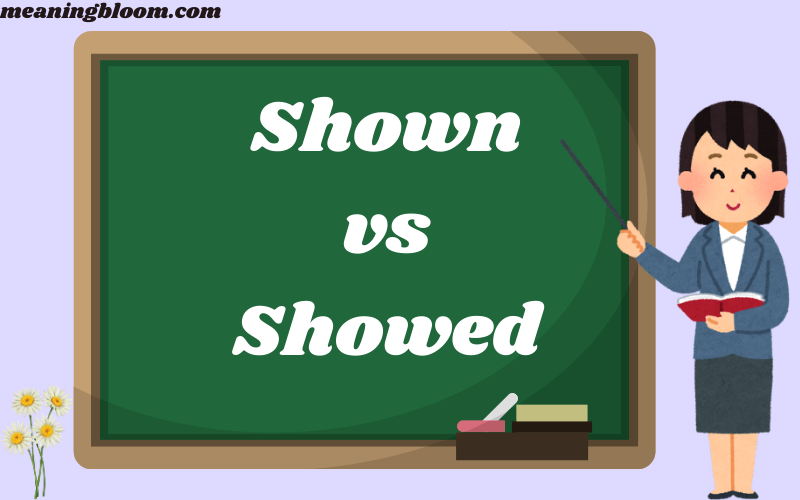
This guide is designed to clear up the confusion once and for all. We’ll break down the difference between shown and showed slowly, clearly, and practically. You’ll get easy-to-follow rules, side-by-side comparisons, examples from everyday conversation, workplace writing, and academic contexts, plus memory tricks to make it stick.
Why “Shown vs Showed” Causes So Much Confusion
The confusion exists for three main reasons:
- “Show” is an irregular verb
- English has multiple past forms (simple past vs past participle)
- Casual speech doesn’t always follow strict grammar rules
Many learners assume that because showed sounds like a past form, it should work everywhere. But English doesn’t work that way — especially with irregular verbs.
Understanding this difference is important because:
- It affects how professional your writing sounds
- It’s very noticeable in emails, reports, and resumes
- Native speakers do judge correctness here (even if subconsciously)
Let’s start at the foundation.
Understanding the Verb “Show” (The Foundation)
The verb show means:
- To make something visible
- To display information
- To demonstrate or explain
It’s one of the most commonly used verbs in English — and also one of the most misused.
The Three Main Forms of “Show”
| Verb Form | Name | Example |
| show | Base / present | I show the results every month. |
| showed | Simple past | She showed her ticket. |
| shown | Past participle | He has shown improvement. |
Key Grammar Fact
“Show” is an irregular verb.
That means it does not follow the regular pattern:
work → worked → worked
Instead, it follows this pattern:
show → showed → shown
This distinction is the key to everything that follows.
What Does “Showed” Mean? (Simple Past Explained)
Showed is the simple past tense of show.
You use it when:
- The action happened in the past
- The action is finished
- There is no helping verb (have, has, had)
Sentence Formula
Subject + showed + object
Correct Examples
- I showed my passport at the airport.
- She showed me her notes.
- They showed great teamwork during the project.
Time Clues That Signal “Showed”
If the sentence includes words like:
- yesterday
- last night
- last year
- in 2020
- earlier today
Then showed is usually the correct choice.
✅ She showed the presentation yesterday.
Important Rule
If you can clearly say when the action happened — and it’s finished — showed is correct.
What Does “Shown” Mean? (Past Participle Explained)
Shown is the past participle of show.
You cannot use it alone.
It must appear with a helping verb:
- have
- has
- had
- will have
Sentence Formula
Subject + helping verb + shown + object
Correct Examples
- I have shown you this before.
- She has shown strong leadership.
- They had shown interest earlier.
Big Rule to Remember
👉 If you see “have,” “has,” or “had,” you must use “shown.”
Never showed.
“Have Showed” vs “Have Shown” (Settled Forever)
Let’s be very clear:
❌ have showed = incorrect
✅ have shown = correct
Why “Have Showed” Is Wrong
Because:
- showed = simple past
- Perfect tenses require a past participle
- The past participle of show is shown
This is the same reason we say:
- I have gone, not have went
- I have done, not have did
- I have shown, not have showed
Grammar Pattern
| Verb | Simple Past | Past Participle |
| go | went | gone |
| do | did | done |
| show | showed | shown |
Once you see the pattern, the rule becomes automatic.
Perfect Tenses Explained Simply (Using “Shown”)
Perfect tenses describe actions that are:
- Completed
- Still relevant to another time
Present Perfect
have / has + shown
Used when the action happened in the past but matters now.
- I have shown you the evidence.
- She has shown real progress.
Past Perfect
had + shown
Used when one past action happened before another.
- He had shown his ID before entering.
- They had shown support earlier.
Future Perfect
will have + shown
Used when something will be completed before a future moment.
- By Friday, she will have shown the final design.
🚫 Replacing shown with showed in any of these breaks the sentence.
Side‑by‑Side Comparison: Shown vs Showed
| Feature | Showed | Shown |
| Verb form | Simple past | Past participle |
| Used with helpers | ❌ No | ✅ Yes |
| Time reference | Finished past | Linked to another time |
| Example | She showed the file. | She has shown the file. |
| Common error | Used with “have” | Never incorrect |
Real‑Life Usage Examples
Everyday Conversation
- I showed him the photos last night. ✅
- I’ve shown him the photos already. ✅
Workplace Writing
❌ The report has showed improvement.
✅ The report has shown improvement.
Academic Writing
- Research has shown that practice improves memory.
Notice how shown adds clarity and authority.
Common Mistakes (And How to Fix Them)
| Mistake | Why It’s Wrong | Correct Form |
| I have showed it. | Wrong participle | I have shown it. |
| She had showed us. | Same issue | She had shown us. |
| He has showed growth. | Non‑standard | He has shown growth. |
| We showed it yesterday. | Correct | ✅ |
Editor’s Tip
When proofreading, circle every “have,” “has,” or “had.”
If the next verb is showed, fix it.
Memory Tricks That Actually Work
Trick #1: The “Have Test”
If the sentence includes have / has / had, the answer is shown.
Trick #2: The “Displayed” Trick
Think of shown as something already on display — complete and presented.
Trick #3: Say It Out Loud
- “I have showed you” → sounds awkward
- “I have shown you” → sounds natural
Trust your ear — grammar often sounds right when it is right.
Can “Shown” Ever Stand Alone?
No.
❌ Shown me the report.
It must have a helper:
✅ You have shown me the report.
Is “Have Showed” Ever Acceptable?
In informal speech, you may hear it — especially in casual American English.
But in:
- Professional writing
- Emails
- Academic work
- Exams
- Blogs
…it is considered incorrect and non‑standard.
Always use have shown.
Mini Quiz (Quick Self‑Test)
- She ___ me the contract yesterday.
- We have ___ strong results this quarter.
- He had ___ interest before the meeting.
Answers
- showed
- shown
- shown
If you got all three right — you’ve got it.
A Workplace Example That Makes the Difference
Original email:
I have showed the updated proposal to the client.
Revised version:
I have shown the updated proposal to the client.
Same meaning — but the second version sounds polished, confident, and professional.
Small grammar choices create big impressions.
Final Takeaway: One Rule to Rule Them All
If you remember nothing else, remember this:
- Showed → simple past (no helper)
- Shown → past participle (with have / has / had)
Or even shorter:
👉 If you have, use shown.
Once this clicks, you’ll never hesitate again — and your English will instantly sound sharper and more confident.
You’ve now shown yourself the rule.
And you won’t forget it.
FAQs
What is the difference between showed and shown?
Showed is the simple past tense of show, used for completed actions in the past. Shown is the past participle, used with helping verbs like have, has, or had.
Can I say “I have showed” in English?
No. The correct form is I have shown. Using have showed is considered non-standard in professional or formal writing.
When should I use showed instead of shown?
Use showed when describing a finished action in the past without a helping verb. Example: “She showed me the photos yesterday.”
Can “shown” stand alone without a helping verb?
No. Shown must always appear with a helping verb. Incorrect: “Shown me the report.” Correct: “You have shown me the report.”
Is “shown” more formal than “showed”?
Yes. Shown is typically used in perfect tenses, which often appear in professional, academic, or polished writing, making it sound more formal and authoritative.
Are “showed” and “shown” interchangeable?
No. They cannot be swapped. Using showed with have/has/had is grammatically incorrect. Always use shown in perfect tenses.
How can I remember whether to use showed or shown?
Try the “have test”: if the sentence includes have, has, or had, use shown. Otherwise, use showed. Saying the sentence out loud also helps: “I have showed” sounds awkward, but “I have shown” sounds natural.
Does casual English allow “have showed”?
In informal speech, especially in American English, people sometimes say have showed. But it is considered incorrect in professional writing, academic work, emails, and exams.
Are you stuck on grammar? You can see our more free guides:
- Gluing vs Glueing? The One Spelling Rule You Must Never Get Wrong
- World-Class vs World Class? The One Spelling Rule You Must Never Get Wrong
- Whichever vs Whatever? The One Spelling Rule You Must Never Get Wrong
- Quieter vs More Quiet? The One Spelling Rule You Must Never Get Wrong
Conclusion
The difference between shown and showed is simpler than it seems once you know the rule:
- Showed → simple past, used for completed actions without a helping verb.
- Shown → past participle, always used with have, has, or had.
Remembering this small detail can make a big difference. Using the correct form not only avoids grammatical mistakes but also makes your English sound clearer, more professional, and more confident — whether in conversation, emails, academic writing, or reports.
A quick memory trick: if the sentence has have, has, or had, use shown. Otherwise, use showed. Saying the sentences out loud can also help your ear recognize what sounds natural.
Mastering this distinction means you’ll never pause or second-guess yourself again. By following these simple guidelines, you’ve now shown yourself the rule — and it’s a skill that will stick for life.