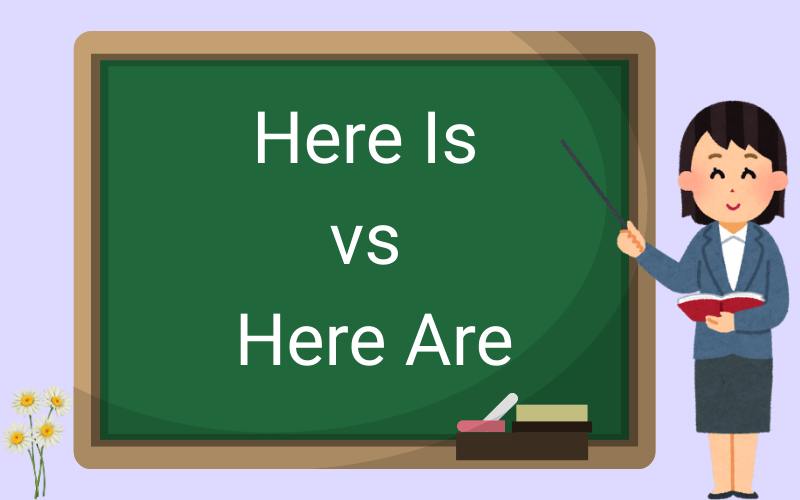

Mastering English grammar often comes down to understanding small structures that quietly control how natural your sentences sound. One of those deceptively simple structures is the choice between “Here is” and “Here are.”
You hear both forms constantly—in classrooms, offices, emails, social media posts, and everyday conversation. Yet even fluent speakers hesitate or make mistakes because the grammar rule works differently from what our ears expect.
This in-depth guide breaks everything down clearly and practically. You’ll learn the rule, the logic behind it, real-world usage, common traps, style differences, advanced cases, and professional writing tips—so you can use Here is and Here are confidently in any situation.
What Do “Here Is” and “Here Are” Actually Mean?
At their core, “Here is” and “Here are” are presentation structures. They introduce, point out, or deliver something to the listener or reader.
- Here is → used before a singular noun
- Here are → used before a plural noun
Examples:
- Here is your passport.
- Here are your documents.
Although “here” comes first, it is not the subject of the sentence. It’s an adverb showing location or emphasis. The real subject appears after the verb, which is why the verb must match that noun.
Core rule: The verb (is/are) always agrees with the noun that follows it.
Why This Grammar Rule Confuses So Many People
If the rule is so simple, why do mistakes happen so often?
The confusion comes from spoken English habits. In speech, people prioritize speed, rhythm, and comfort over strict grammatical accuracy. This leads to contractions and shortcuts that sound natural but don’t follow formal grammar rules.
For example:
- ❌ Here’s your keys.
- ✅ Here are your keys.
The contraction “Here’s” (Here is) is easier to say than “Here are,” so speakers often use it automatically—even when the noun is plural.
In conversation, this rarely causes misunderstanding. In writing, however, it stands out as incorrect.
Understanding Subject–Verb Agreement in This Structure
To use Here is and Here are correctly, you must understand how subject–verb agreement works when the subject comes after the verb.
Normally, English sentences follow this order:
Subject → Verb → Object
But in this structure, the order flips:
Here → Verb → Subject
Examples:
- Here is the answer.
- Here are the answers.
Even though the subject appears later, it still controls the verb.
Quick Accuracy Test
Replace the phrase with:
- This is (singular)
- These are (plural)
If “this is” sounds right, use is. If “these are” sounds right, use are.
Singular Nouns: When to Use “Here Is”
Use Here is when the noun refers to one item, person, idea, or uncountable concept.
Examples:
- Here is your phone.
- Here is the final decision.
- Here is my suggestion.
Uncountable Nouns
Uncountable nouns are treated as singular, even though they may refer to large amounts.
Common examples:
- Information
- Advice
- Furniture
- Equipment
- Knowledge
Correct usage:
- Here is the information you requested.
- Here is some advice for beginners.
Incorrect:
- ❌ Here are the information.
- ❌ Here are some advice.
Plural Nouns: When to Use “Here Are”
Use Here are when presenting more than one thing.
Examples:
- Here are your shoes.
- Here are the reasons for the delay.
- Here are three options to consider.
If the noun can be counted and is more than one, are is required—no exceptions in formal English.
The Contraction Trap: “Here’s”
The contraction “Here’s” is one of the biggest sources of mistakes.
While it is technically short for Here is, people frequently use it with plural nouns:
- ❌ Here’s your documents.
- ❌ Here’s the keys.
Why does this happen?
- It’s quicker to say
- It flows better in speech
- The brain locks onto the contraction, not the noun
Formal vs Informal Usage
- Informal speech: Common but grammatically incorrect
- Formal writing: Always wrong
In professional emails, blogs, academic writing, and business documents, avoid using Here’s before plural nouns.
Countable vs Uncountable Nouns: A Crucial Distinction
Understanding noun types helps prevent mistakes.
Countable Nouns
Things you can count individually:
- Book / books
- Email / emails
- Ticket / tickets
Examples:
- Here is a ticket for you.
- Here are your tickets.
Uncountable Nouns
Things you cannot count individually:
- Water
- Research
- Luggage
Examples:
- Here is your luggage.
- Here is the research data.
Collective Nouns and Regional Differences
Collective nouns refer to groups acting as a unit.
Examples:
- Team
- Staff
- Family
- Committee
American English
Treats collective nouns as singular:
- Here is the team lineup.
British English
Often treats them as plural:
- Here are the team members.
Both are acceptable depending on region and context, but consistency matters.
Lists and Mixed Nouns
When introducing a list, the verb depends on how the speaker views the items.
Examples:
- Here is your pen and notebook. (seen as one set)
- Here are your pen and notebook. (seen as two items)
Neither is automatically wrong—the meaning determines the grammar.
“Here Is / Are” vs “There Is / Are”
These structures follow the same grammar rules but serve different purposes.
- There is/are → introduces existence
- Here is/are → emphasizes presence or delivery
Examples:
- There is a problem with the system.
- Here is the solution.
Pronouns After “Here”
Pronouns follow a different word order.
Incorrect:
- ❌ Here are they.
Correct:
- ✅ Here they are.
The pronoun comes after the verb, not directly after “here.”
Common Mistakes in Professional Writing
Emails
❌ Here’s the files you requested.
✅ Here are the files you requested.
Reports
❌ Here’s the details of the project.
✅ Here are the details of the project.
Academic Writing
❌ Here’s the data that supports the theory.
✅ Here are the data that support the theory.
Small corrections like these significantly improve credibility.
Style Tips for Writers and Editors
- Identify the real subject before choosing the verb
- Avoid contractions in formal contexts
- Treat uncountable nouns as singular
- Read sentences aloud to catch rhythm-based errors
- Be consistent with regional grammar rules
Why This Rule Still Matters Today
Language evolves, but standard grammar still matters in:
- SEO content
- Academic papers
- Business communication
- Professional branding
Correct usage signals clarity, education, and attention to detail.
Frequently Asked Questions
Is “Here’s your keys” ever correct?
Not grammatically. It’s common in speech but incorrect in writing.
Can “data” be singular?
Informally yes, academically no.
Does this rule change in British English?
No—the core rule is the same.
FAQs
What is the difference between “Here is” and “Here are”?
The difference depends on whether the noun is singular or plural.
Use “Here is” when the noun is singular or uncountable, and use “Here are” when the noun is plural.
Example:
- Here is your book.
- Here are your books.
Is it correct to say “Here’s your keys”?
No, it is not grammatically correct. “Here’s” is a contraction of “Here is,” which should only be used with singular nouns. When the noun is plural, you should use “Here are.”
Correct example:
Here are your keys.
Why do people often say “Here’s” with plural nouns?
In casual speech, people often use “Here’s” because it is easier and faster to say than “Here are.” Although it is common in everyday conversation, it is still considered incorrect in formal writing.
Can “Here is” be used with uncountable nouns?
Yes, “Here is” is used with uncountable nouns because they are treated as singular.
Examples:
- Here is the information you requested.
- Here is some advice for you.
How can I quickly decide whether to use “Here is” or “Here are”?
A simple trick is to replace the phrase with “This is” or “These are.”
- If “This is” sounds correct, use Here is.
- If “These are” sounds correct, use Here are.
Example:
These are the files → Here are the files.
Is it acceptable to use “Here’s” in formal writing?
It is better to avoid contractions like “Here’s” in formal or professional writing, especially when introducing plural nouns. Using the full form “Here are” or “Here is” keeps the sentence grammatically correct and professional.
Are you stuck on grammar? You can see our more free guides:
- ALR Meaning in Text: What It Means & How to Use It 2026
- STSU Meaning in Text: What It Means & How to Use It 2026
- Flew or Flown: What’s the Difference and Which One Is Correct?
- TS Meaning in Text: What It Means & How to Use It 2026
Conclusion
Understanding the difference between “Here is” and “Here are” may seem like a small detail, but it plays an important role in making your English clear and grammatically correct. The rule is simple: use “Here is” with singular or uncountable nouns and “Here are” with plural nouns. By focusing on the noun that comes after the verb, you can easily choose the correct form.
Although casual speech sometimes bends the rule with contractions like “Here’s,” accurate usage is important in formal writing, emails, academic work, and professional communication. Once you practice identifying the real subject of the sentence, using “Here is” and “Here are” will become natural—helping your writing sound clearer, more confident, and more polished.