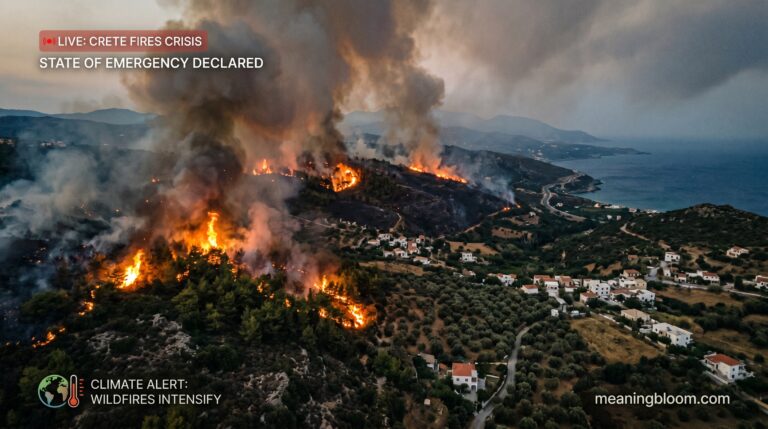
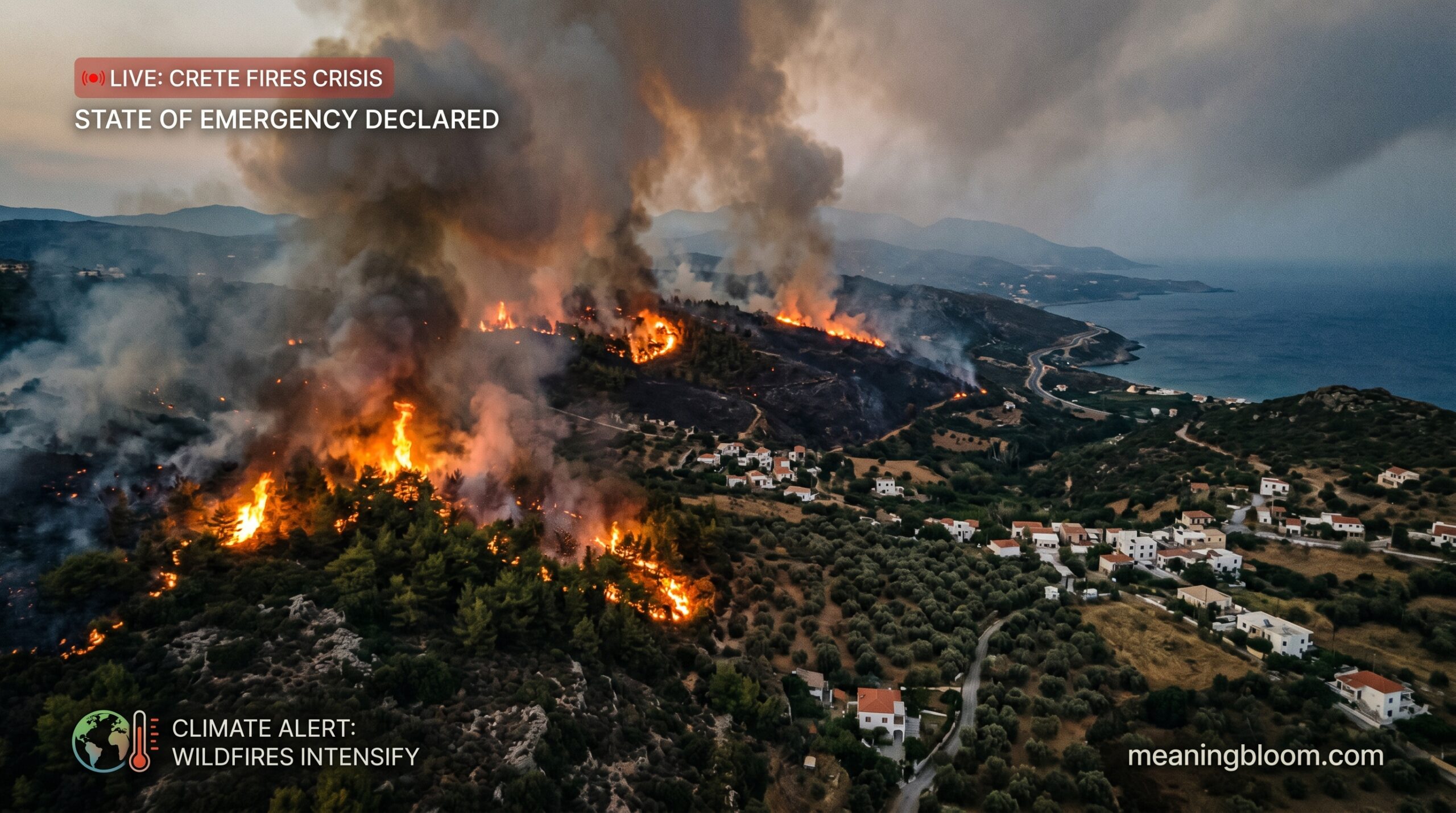

The Crete wildfires are no longer just seasonal natural disasters; they have evolved into a complex environmental, social, and climatic crisis that reflects the broader instability of the Mediterranean region. Unlike ordinary forest fires, Crete wildfires now occur with increasing unpredictability, intensity, and destructive power, reshaping the island’s landscapes and threatening its long-term ecological balance.
Crete, with its ancient history, mountain ranges, olive groves, and coastal beauty, has always been considered one of the most resilient ecosystems in Greece. However, in recent years, this resilience has been tested repeatedly by extreme fire events. The rise of Crete wildfires is deeply connected to climate change, human expansion, and environmental mismanagement, making it a multi-layered issue rather than a simple natural phenomenon.
What makes Crete wildfires especially concerning is not just their frequency but their behavior. Fires now move faster, burn hotter, and spread across larger areas than in previous decades. Scientists link this shift to rising atmospheric temperatures, reduced rainfall, and prolonged drought cycles. At the same time, human activity continues to increase ignition sources, creating a dangerous combination of natural vulnerability and human pressure.
This article presents a unique, in-depth, and different perspective on Crete wildfires, focusing not only on causes and effects but also on hidden patterns, long-term consequences, and less-discussed realities that shape the future of the island.
The Changing Nature of Crete Wildfires
From Seasonal Fires to Continuous Threat
In the past, wildfires in Crete were mostly seasonal and predictable. They occurred during peak summer months and were often limited in scale. Today, Crete wildfires are no longer confined to a specific season. Due to changing climate conditions, fires can now ignite earlier in spring and continue later into autumn.
This shift indicates a deeper environmental transformation. The land is becoming increasingly dry for longer periods, which means the natural “safe window” for vegetation recovery is shrinking every year.
Increased Fire Intensity and Speed
Modern Crete wildfires behave differently from historical fire events. They burn with higher intensity and spread much faster due to drier vegetation and stronger wind patterns. In some cases, fire fronts can move so quickly that evacuation becomes the only option rather than containment.
This increased speed is one of the most dangerous aspects of recent wildfire behavior, making traditional firefighting methods less effective in certain regions.
Fragmented Landscapes and Fire Spread
Another unique factor in Crete wildfires is the changing structure of land use. Urban expansion, tourism infrastructure, and abandoned rural areas have created fragmented landscapes. These fragmented zones act as “fire corridors,” allowing flames to jump between natural and human-made environments more easily.
Hidden Drivers Behind Crete Wildfires
Microclimate Shifts in the Island
One often overlooked factor behind Crete wildfires is the creation of microclimate changes within the island itself. As forests shrink and urban areas expand, localized temperature differences increase. Certain areas become hotter and drier than surrounding regions, creating hotspots where fires are more likely to start and spread.
Soil Dryness and Long-Term Dehydration
The soil in Crete is experiencing long-term moisture loss. This means that even during cooler months, the ground does not fully recover its water content. As a result, vegetation grows weaker and becomes more vulnerable to ignition. This hidden dryness is a major contributor to Crete wildfires, even when surface conditions appear normal.
Human Pressure Beyond Ignition
While human activity is often blamed for starting fires, its deeper impact lies in altering ecosystems. Construction, tourism development, and road expansion have reduced natural fire barriers. These changes make Crete wildfires more difficult to control once they begin, even if humans are not the direct cause of ignition.
Environmental Transformation Caused by Crete Wildfires
The Shift from Forest to Shrubland
One of the most significant long-term impacts of Crete wildfires is ecological transformation. Repeated fires prevent forests from fully regenerating. Instead of dense tree cover, the land gradually shifts toward shrubland and grassland ecosystems.
This change may seem natural, but it reduces biodiversity and increases future fire risk, creating a self-reinforcing cycle.
Loss of Native Species Balance
Crete has many unique plant and animal species adapted to its Mediterranean climate. However, Crete wildfires disrupt this balance by destroying slow-growing native plants while allowing fast-growing invasive species to dominate.
Over time, this leads to a simplified ecosystem that is less stable and more fire-prone.
Invisible Damage to Soil Microorganisms
Beyond visible destruction, Crete wildfires also damage soil microorganisms that are essential for nutrient cycling. These microscopic organisms take years to recover, and their loss weakens the entire ecosystem’s ability to regenerate naturally.
Social and Human Dimensions of Crete Wildfires
The Psychological Impact on Communities
The human experience of Crete wildfires goes beyond physical damage. Communities living in fire-prone areas develop long-term psychological stress, especially after repeated evacuations. Fear of sudden fire outbreaks becomes part of daily life during summer months.
Children and elderly populations are particularly affected, as evacuation events create uncertainty and emotional trauma.
Rural Depopulation and Abandonment
Repeated Crete wildfires are also contributing to rural abandonment. Farmers and villagers in high-risk areas are gradually moving to safer urban zones. This migration leaves behind unmanaged land, which ironically increases wildfire risk even further.
This creates a cycle where human absence leads to environmental neglect, which then increases fire vulnerability.
Economic Dependency and Fragility
Crete’s economy is heavily dependent on tourism and agriculture. Crete wildfires disrupt both sectors simultaneously. While tourism suffers from damaged landscapes and safety concerns, agriculture suffers from destroyed crops and reduced soil fertility.
This dual impact makes recovery more difficult compared to other types of natural disasters.
Fire Behavior and Scientific Observations
Wind-Driven Fire Acceleration
One of the most scientifically significant aspects of Crete wildfires is their strong dependence on wind behavior. Winds not only spread fire but also reshape fire direction unpredictably. This makes modeling wildfire behavior extremely complex.
Fire-Induced Weather Systems
In extreme cases, Crete wildfires generate their own weather systems. Rising heat can create upward air currents that form fire clouds, which further intensify wind speeds and spread embers across long distances.
Ember Transport Phenomenon
A lesser-known feature of Crete wildfires is ember transport. Small burning particles can travel kilometers ahead of the main fire front, starting new fires in separate locations. This makes containment extremely difficult and explains why fires sometimes appear in multiple areas simultaneously.
Emergency Systems and Their Limitations
Resource Constraints
Although firefighting systems in Greece have improved, Crete wildfires often exceed available resources. Helicopters, fire trucks, and personnel are limited when multiple fires occur at the same time.
Terrain Challenges
Crete’s mountainous geography creates natural barriers for firefighting. Many fire zones are inaccessible by road, forcing reliance on aerial support. This limits the speed and efficiency of response during Crete wildfires.
Communication Gaps
During major wildfire events, communication systems can become overloaded. This affects coordination between emergency services and delays evacuation instructions in some cases.
Long-Term Ecological Future of Crete
Possible Desertification Risk
If current trends continue, parts of Crete may face partial desertification due to repeated Crete wildfires. Loss of vegetation, combined with soil degradation, could reduce land productivity over time.
Shift in Biodiversity Patterns
Future ecosystems may look very different from today. Fire-resistant species may dominate, while slower-growing trees may disappear from certain regions entirely due to repeated Crete wildfires.
Climate Feedback Loop Expansion
As vegetation decreases, carbon absorption capacity also declines. This means Crete wildfires indirectly contribute to further warming, creating a feedback loop that increases future fire risk.
Future Strategies for a Fire-Resilient Crete
Landscape-Level Planning
Instead of focusing only on firefighting, future strategies must redesign landscapes to reduce fire spread. This includes creating natural firebreaks and restoring native vegetation patterns.
Community-Based Prevention Systems
Local communities can play a major role in preventing Crete wildfires through monitoring, reporting, and maintaining land cleanliness in rural zones.
Smart Technology Integration
AI-based fire prediction systems, satellite monitoring, and real-time wind analysis can improve early detection of Crete wildfires, reducing response time significantly.
Read Also: Crete Fires: A Complete In-Depth Analysis of Wildfire Crisis in Crete
Conclusion
The reality of Crete wildfires is far more complex than simple seasonal forest fires. They represent a deep transformation of climate, land use, and ecological balance on the island. These fires are not only destroying natural landscapes but also reshaping the future identity of Crete itself.
What makes Crete wildfires truly dangerous is their interconnected nature—climate change intensifies dryness, human activity increases ignition sources, and altered landscapes accelerate fire spread. Together, these factors create a cycle that becomes harder to break each year.
If long-term solutions are not implemented, Crete wildfires may continue to intensify, leading to permanent ecological and economic changes. However, with coordinated action, smart planning, and environmental awareness, it is still possible to reduce their impact and protect the island’s future.