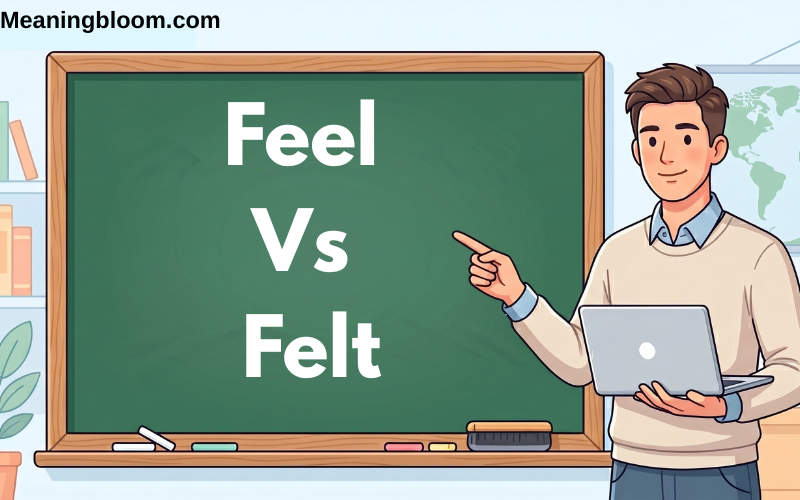

Feel vs Felt is a common grammar topic that confuses many English learners and even native speakers. Because both words come from the same verb, they look closely related, yet they serve different purposes in a sentence. Choosing the wrong form can make your writing sound unnatural and can confuse readers about when an emotion, sensation, or experience actually happened.
For example, saying “I feel excited about my vacation” refers to a present emotion, while “I felt excited when I booked my ticket” describes an emotion that happened in the past. This small change in verb tense creates a completely different meaning. In this guide, you’ll learn the difference between feel and felt, when to use each one, common mistakes to avoid, and practical examples that will help you use both words confidently in everyday English.
Why “Feel” vs “Felt” Confuses So Many Learners
The confusion exists for one simple reason:
Both words describe emotion, sensation, or perception—but they live in different moments in time.
- Feel talks about the present, the future, or general truths.
- Felt talks about the past—something already experienced.
Compare:
- I feel calm right now.
- I felt calm after the exam.
Same emotion. Same verb family. Different time.
That small shift changes how your listener understands when the experience happened—and how close or distant it feels emotionally.
The Core Meaning of “Feel”
Feel is a highly expressive verb. It connects your inner world—emotions, thoughts, physical sensations—to language.
What “Feel” Means
Feel means to experience something emotionally, physically, or mentally in the present or as a general condition.
It can describe:
- How your body reacts
- How your emotions respond
- What your opinion or intuition tells you
Common Uses of “Feel”
1. Physical Sensations
- I feel cold.
- Do you feel the vibration?
- She feels pain in her shoulder.
2. Emotions
- I feel excited about the future.
- He feels anxious before flying.
- They feel proud of their work.
3. Opinions and Beliefs
- I feel this plan will succeed.
- She feels that honesty matters most.
- We feel it’s the right decision.
Here, feel replaces “think” or “believe” but adds emotional weight.
Grammar Patterns with “Feel”
| Structure | Example | Meaning |
| Present Simple | I feel tired. | Current or general state |
| Present Continuous | I’m feeling tired. | Temporary or changing state |
| Modal Verb | You should feel confident. | Advice or expectation |
| Linking Verb | She feels happy. | Subject + adjective |
💡 Grammar Tip:
“Feel” often works as a linking verb, meaning it connects the subject to an adjective—not an action.
- I feel hopeful.
- He feels nervous.
Understanding “Felt”: The Language of the Past

If feel belongs to the present, then felt belongs to memory.
Felt is both:
- the simple past tense, and
- the past participle of feel
When to Use “Felt”
Use felt when:
- The emotion or sensation already happened
- You’re reflecting on an experience
- The moment is finished
Examples:
- I felt relieved after hearing the news.
- She felt nervous during the interview.
- We felt grateful for their support.
The emotion may still matter—but the moment has passed.
Grammar Structures with “Felt”
| Tense | Example | Usage |
| Simple Past | I felt happy. | Finished past emotion |
| Past Perfect | I had felt afraid before. | Earlier past |
| Present Perfect | I have felt this before. | Past experience with present relevance |
✅ Quick Rule:
If you can say yesterday, last night, earlier, or before—you probably need felt.
Feel vs Felt: Side‑by‑Side Comparison
| Sentence Type | Feel | Felt |
| Statement | I feel fine. | I felt fine. |
| Emotion | She feels confident. | She felt confident. |
| Sensation | I feel the heat. | I felt the heat. |
| Opinion | I feel that it’s fair. | I felt that it was unfair. |
Basic Pattern
Subject + feel/felt + complement
- I feel optimistic.
- I felt the tension immediately.
Choosing the Right Verb: Context Matters

Grammar is important—but context makes the final decision.
Use “Feel” When:
- The emotion is happening now
- The feeling is habitual
- You’re stating a general truth
Examples:
- I feel tired every morning.
- I feel confident when I practice.
Use “Felt” When:
- You’re recalling a specific moment
- The emotion is complete
- You want emotional distance
Examples:
- I felt disappointed yesterday.
- He felt ignored during the meeting.
Subtle Nuance
- I feel hurt. → The pain is active.
- I felt hurt. → The pain happened, maybe healed.
Think of feel as now and felt as then.
Idiomatic Expressions with “Feel” and “Felt”
English uses feel heavily in idioms, making it essential for fluency.
| Expression | Meaning | Example |
| Feel free | You’re welcome to | Feel free to ask questions. |
| Feel like | Want to | I feel like resting. |
| Feel for someone | Sympathize | I feel for her situation. |
| Feel at home | Be comfortable | Please feel at home. |
| Feel under the weather | Slightly ill | I feel under the weather today. |
| Felt it in my bones | Strong intuition | I felt it in my bones. |
Idioms rarely change tense unless context demands it:
- I felt under the weather yesterday.
Advanced Grammar: Modals and Perfect Tenses

With Modal Verbs
- You should feel proud.
- I can feel the tension.
- They might feel nervous.
Modals change attitude, not tense.
With Perfect Tenses
| Form | Example | Meaning |
| Present Perfect | I have felt lonely before. | Past experience affecting now |
| Past Perfect | I had felt unsure earlier. | Earlier past |
| Future Perfect | I will have felt better by then. | Future reflection |
💡 Insight:
“Have felt” suggests experience over time, not a single moment.
Emotional Tone: Why Writers Care About Feel vs Felt
Verb tense controls emotional distance.
- I feel betrayed. → Immediate, raw emotion
- I felt betrayed. → Reflection, processing
In Storytelling
Writers often shift tense to pull readers closer:
I felt fear rising, and suddenly I feel my heart race again.
That switch brings memory into the present.
Pronunciation and Common Errors
Pronunciation
| Word | Sound |
| Feel | /fiːl/ (like “wheel”) |
| Felt | /fɛlt/ (like “belt”) |
Common Mistakes
❌ I felt happy now.
✔ I feel happy now.
❌ I feel sad yesterday.
✔ I felt sad yesterday.
❌ He has feel this pain.
✔ He has felt this pain.
Bonus Note
Felt is also a noun (fabric):
- The jacket is made of felt.
Context always makes meaning clear.
Regional and Stylistic Differences
Grammar stays the same worldwide, but tone changes.
| Region | Style | Example |
| American English | Direct emotion | I feel amazing. |
| British English | More reserved | I felt rather tired. |
| Australian English | Idiomatic | I feel like a cuppa. |
Formal vs Informal
- Formal: I felt the impact of the decision.
- Informal: I feel like it hit me hard.
Quick Reference Table
| Function | Verb | Example |
| Present | Feel | I feel fine. |
| Past | Felt | I felt fine. |
| Experience | Have felt | I have felt this before. |
| Desire | Feel like | I feel like sleeping. |
| Opinion | Feel that | I feel that it’s fair. |
Practice: Choose Feel or Felt
- I ____ nervous before the presentation.
- I always ____ thankful for support.
- She ____ something was wrong last night.
- Do you ____ better now?
- We ____ relieved after the results.
Answers
- felt
- feel
- felt
- feel
- felt
FAQs
What is the difference between feel and felt?
Feel is used for present situations, ongoing emotions, or general truths, while felt is used for past experiences and completed emotions.
Example:
- I feel happy today.
- I felt happy after hearing the good news.
Is felt the past tense of feel?
Yes. Felt is both the simple past tense and the past participle of feel.
Example:
- Yesterday, I felt tired.
- I have felt this way before.
Can I use feel for something that happened yesterday?
No. If the action happened in the past, you should use felt.
❌ I feel sick yesterday.
✔ I felt sick yesterday.
When should I use feel in a sentence?
Use feel when talking about current emotions, physical sensations, opinions, or general states.
Example:
- I feel confident about the exam.
- We feel this decision is fair.
Can feel and felt both describe emotions?
Yes. Both words describe emotions, but they refer to different time periods.
Example:
- I feel excited about the event. (Present)
- I felt excited during the event. (Past)
What is the past participle of feel?
The past participle of feel is felt.
Example:
- She has felt nervous before every interview.
- They have felt this pressure for months.
Which is correct: “I feel better now” or “I felt better now”?
I feel better now is correct because now refers to the present.
✔ I feel better now.
❌ I felt better now.
Can I use feel to express an opinion?
Yes. Feel is commonly used to express opinions in a polite and natural way.
Example:
- I feel that this solution will work.
- We feel the project should continue.
Is felt always used for the past?
When used as a verb, yes. However, felt can also be a noun referring to a type of fabric.
Example:
- I felt relieved after the exam. (Verb)
- The hat is made of felt. (Noun)
How can I easily remember the difference between feel and felt?
A simple trick is:
Feel = Present
Felt = Past
Example:
- I feel nervous before presentations.
- I felt nervous during yesterday’s presentation.
Conclusion
Understanding feel vs felt is essential for expressing emotions, opinions, and experiences accurately in English. The key difference is simple: feel is used for present situations, ongoing emotions, and general truths, while felt is used for emotions, sensations, or experiences that happened in the past.
Consider these examples: “I feel nervous before interviews” describes a current or habitual feeling, whereas “I felt nervous during yesterday’s interview” refers to a completed past experience. By remembering this time-based distinction, you’ll be able to choose the correct verb naturally and avoid one of the most common tense mistakes in English. Mastering feel and felt will make your writing clearer, more professional, and easier for readers to understand.