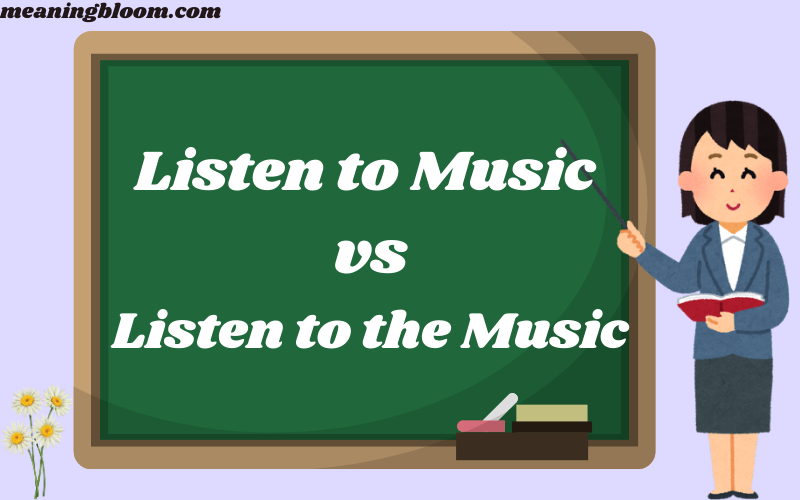

English has a clever way of hiding big meaning inside tiny words. One small article — “the” — can completely change what a sentence points to, how it sounds, and whether it feels natural to a fluent speaker. Even simple phrases like “listen to music” and “listen to the music” look almost identical, but their meaning is surprisingly different. Many learners assume they’re interchangeable — and that’s where confusion begins.
This guide breaks down the difference clearly and practically. You’ll learn when to use each phrase, how native speakers naturally choose between them, common mistakes to avoid, and simple memory tricks to make your choice automatic. By the end, you’ll confidently use the right form every time and sound more fluent, natural, and precise in English.
Why This Small Difference Actually Matters
In everyday English, articles like a, an, and the don’t just decorate sentences — they control meaning.
Compare these two statements:
- I listen to music while working.
- Listen to the music while working.
The first describes a general habit. The second sounds like an instruction about a specific sound.
Native speakers instantly hear the difference. Learners often don’t — and that gap is what causes hesitation, awkward phrasing, or misunderstandings.
Understanding this distinction improves:
- clarity
- fluency
- natural tone
- grammatical accuracy
Let’s break it down from the foundation up.
The Core Grammar Rule: What Kind of Noun Is “Music”?
To understand both phrases, you need to understand how English treats the word music.
Music as an Uncountable Noun
In most situations, music is an uncountable noun. That means:
- It has no plural form (musics ❌)
- It usually appears without an article when speaking generally
Examples:
- I love music.
- Music helps me relax.
- She studies music theory.
Here, music means the idea or category of musical sound.
Music as a Specific Reference
When you add the, you change the meaning.
The music refers to:
- a particular sound
- a known performance
- music already mentioned
- music happening right now
Example:
- The music from upstairs is too loud.
Now the listener knows exactly which music you mean.
Quick Grammar Snapshot
| Form | Article | Meaning |
| music | none | music in general |
| the music | definite article | specific, identifiable sound |
The article doesn’t change the word — it changes the focus.
“Listen to Music” — Meaning, Tone, and Usage
What “Listen to Music” Means
Listen to music refers to the general activity of hearing or enjoying music. It describes habits, preferences, routines, and hobbies.
It does not point to any particular song or sound.
Examples:
- I listen to music while studying.
- She listens to music on her way to work.
- Do you listen to music every day?
In each sentence, the speaker means any music at all.
Common Situations Where It’s Used
Native speakers use listen to music when talking about:
- lifestyle habits
- personal taste
- daily routines
- general discussions
Examples by context:
Habits
- He listens to music before sleeping.
Preferences
- I prefer to listen to music instead of podcasts.
General statements
- Listening to music can reduce stress.
Natural Collocations With “Listen to Music”
Some words naturally pair with this phrase:
| Collocation | Example |
| listen to music online | Many people listen to music online now. |
| listen to music quietly | She listens to music quietly at night. |
| listen to music while working | I listen to music while working from home. |
| listen to music on headphones | He listens to music on headphones. |
| listen to music for fun | They listen to music for fun, not professionally. |
All of these describe non‑specific activity.
“Listen to the Music” — Meaning and Intent
What Changes When You Add “The”
Adding the transforms the phrase.
Listen to the music means:
Pay attention to this particular music.
The speaker expects the listener to recognize or notice the sound.
Examples:
- Listen to the music — it’s starting.
- Listen to the music coming from that room.
- Listen to the music carefully.
The focus is no longer a habit. It’s this moment.
Situations Where “Listen to the Music” Sounds Natural
You’ll hear this phrase when:
- music is currently playing
- the music was mentioned earlier
- the speaker is directing attention
- instruction or emphasis is involved
Examples:
At an event
- Listen to the music — the band is incredible.
In teaching
- Listen to the music and follow the rhythm.
In conversation
- Listen to the music in the background.
Meaning Comparison
| Sentence | What It Communicates |
| Listen to music. | General activity |
| Listen to the music. | Specific sound |
A single word creates a completely different message.
Grammar Structure You Must Get Right

No matter which phrase you use, the structure stays the same.
Correct Structure
Subject + listen + to + object
Examples:
- I listen to music.
- She listened to the music.
Common Error to Avoid
❌ I listen music.
✅ I listen to music.
The verb listen always requires to.
Side‑by‑Side Context Comparison
| Context | Correct Phrase | Example |
| Daily routine | listen to music | I listen to music while cooking. |
| Specific sound | listen to the music | Listen to the music playing outside. |
| Classroom | listen to the music | Listen to the music for pronunciation. |
| Hobby | listen to music | She listens to music for relaxation. |
| Performance | listen to the music | Listen to the music — it’s live. |
Real‑Life Conversation Example
Situation: Two coworkers
- A: I usually listen to music when I work.
- B: Same — but listen to the music right now. It’s calming.
Here’s what changed:
| Phrase | Focus |
| listen to music | general habit |
| listen to the music | current sound |
This is how native speakers naturally shift meaning.
Common Mistakes Learners Make
Mistake 1: Thinking They’re Interchangeable
They aren’t. Article choice affects meaning.
Mistake 2: Using “the” for Formality
The is about specificity, not formality.
Mistake 3: Pluralizing Music
❌ the musics
✅ the music
Mistake 4: Dropping “to”
❌ listen music
✅ listen to music
Subtle and Creative Uses
English allows flexibility in artistic or metaphorical language.
Examples:
- Listen to the music of your heart.
- Listen to the music within you.
Even here, the music implies a specific feeling or idea, not music in general.
Simple Memory Tricks That Always Work
Trick 1: THE = THAT
If you can replace the with that, it’s correct.
- Listen to that music. ✔
Trick 2: Point Test
If you can point to the sound, use the.
Trick 3: Book Analogy
- Read books → general
- Read the book → specific
Same logic applies.
Frequently Asked Questions
Is “listen to the music” grammatically correct?
Yes, when the music is specific or identifiable.
Which is more common?
“Listen to music” is more common because it describes habits.
Why doesn’t music usually take an article?
Because it’s uncountable when used generally.
Can both ever be correct?
Yes — but they mean different things depending on context.
FAQs
Is “listen to the music” grammatically correct?
Yes, it is correct when you are referring to a specific or identifiable piece of music.
Which phrase is more common?
“Listen to music” is more common in everyday English because it refers to general habits, routines, or preferences.
Why doesn’t “music” usually take an article?
Because music is an uncountable noun when used generally. Articles like “the” are only used when referring to specific music.
Can both “listen to music” and “listen to the music” be correct in the same sentence?
Yes, but they convey different meanings:
- Listen to music → general activity or habit
- Listen to the music → specific sound, song, or performance
Can I use “the” to sound more formal?
No. The is about specificity, not formality. Using it incorrectly can confuse the listener.
What’s a simple trick to know when to use “the”?
- Replace the with that. If it still makes sense, then it’s correct.
Point to the music — if you can point, use the.
Are there creative ways to use “listen to the music”?
Yes. In artistic or metaphorical language, you can say things like:
- “Listen to the music of your heart.”
- “Listen to the music within you.”
Are you stuck on grammar? You can see our more free guides:
- To Early vs Too Early? The One Spelling Rule You Must Never Get Wrong
- Smoothe vs Smooth? The One Spelling Rule You Must Never Get Wrong
- Feel Vs Felt? The One Spelling Rule You Must Never Get Wrong
- Sale vs Sail? The One Spelling Rule You Must Never Get Wrong
Conclusion
The difference between “listen to music” and “listen to the music” comes down to one simple idea: specificity.
Use listen to music when talking about general habits, routines, or preferences. It refers to music in a broad sense, without pointing to any particular sound.
Use listen to the music when you want to draw attention to a specific song, performance, or sound. This small article — “the” — instantly narrows the focus and makes your meaning clear to native speakers.
Mastering this distinction helps you speak and write more naturally, fluently, and accurately. Once you connect “the” with specific reference, choosing the right phrase becomes automatic — and that’s how a tiny word can quietly transform your English.