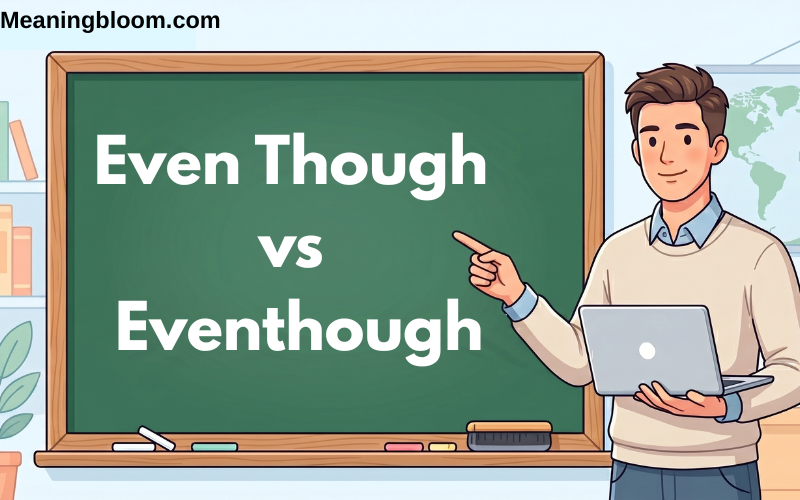

Eventhough or Even Though is one of the most common spelling and grammar confusions in English writing. Because both forms sound exactly the same when spoken, many writers assume they are interchangeable. However, only one version is accepted in standard English, while the other is considered a spelling mistake. Understanding this difference is important because even a small error can affect the clarity, professionalism, and credibility of your writing.
For example:
❌ Eventhough I studied hard, I failed the test.
✅ Even though I studied hard, I failed the test.
In this guide, you’ll learn which form is correct, why people often make this mistake, how grammar rules explain the difference, and simple tricks to ensure you never use the wrong version again.
The Short Answer (For Busy Readers)
Let’s clear it up immediately:
- ✅ Even though — correct, standard, and accepted everywhere
- ❌ Eventhough — incorrect, nonstandard, and never acceptable
No exceptions. No informal loopholes. No regional variations.
Now let’s dig into why.
Why This Small Error Makes a Big Difference
At first glance, joining two words into one might seem trivial. But language doesn’t work that way—especially written English.
Grammar errors, even tiny ones, influence how readers judge your intelligence, accuracy, and professionalism. Studies in linguistics and digital communication consistently show that readers form opinions about writers within seconds, often based on spelling and grammar alone.
Imagine reading these two sentences:
- Eventhough we appreciate your interest, we cannot proceed.
- Even though we appreciate your interest, we cannot proceed.
The message is the same, yet the impression is wildly different. One feels polished and competent. The other feels rushed or careless.
This matters in:
- Academic essays and exams
- Business emails and proposals
- Blogs and SEO content
- Job applications and resumes
- Social media posts meant to build authority
One missing space can quietly damage trust.
Why “Eventhough” Feels Right to So Many People
If eventhough is wrong, why do so many people write it?
The answer lies in how English is spoken versus how it is written.
1. Sound Blending in Natural Speech
In fast, natural speech, English speakers blend sounds together. Even though is often pronounced something like:
ee-vn-thoh
Your ear hears one smooth unit, not two separate words. When your brain later tries to write what it heard, it guesses a single word.
2. Visual Pattern Traps
English contains many fused words:
- although
- nevertheless
- however
- therefore
Your brain subconsciously assumes eventhough follows the same pattern—even though it doesn’t.
3. Internet Reinforcement
The internet unintentionally spreads mistakes. When people see eventhough repeated in comments, captions, and posts, the error starts to look legitimate.
Repetition creates familiarity—but familiarity does not equal correctness.
The Grammar Rule (Explained Without Jargon)
From a grammatical standpoint, even though is a two-word subordinating conjunction.
That sounds complicated, but the idea is simple:
- Even intensifies emphasis
- Though introduces contrast
Together, they link two ideas that contradict or oppose each other.
Correct Structure
Even though + dependent clause, main clause
Example:
Even though the deadline was tight, she delivered excellent work.
The first part cannot stand alone. The second part completes the meaning.
Why “Eventhough” Breaks Grammar
When you write eventhough as one word:
- It no longer fits any grammatical category
- It isn’t recognized as an adverb, conjunction, or compound
- It violates English word-formation rules
That’s why no grammar system accepts it.
A Helpful Substitution Test
Here’s a quick way to check yourself:
If you can replace the phrase with although or despite the fact that, then even though is the correct choice.
Example:
- Even though he was tired, he kept working.
- Although he was tired, he kept working.
If the sentence still makes sense, you’re using it correctly.
A Brief History of “Even Though”
The phrase even though has deep roots in English.
- Though dates back to Old English (þēah), used to express concession
- Even developed as an intensifier meaning “exactly” or “in spite of”
By the Middle English period, writers began combining the two—not as a single word, but as a reinforced phrase.
Historical texts consistently show even though written as two separate words for centuries. Linguistic databases and corpora confirm this pattern.
In contrast, eventhough appears only in modern informal writing as a spelling mistake—not as an accepted evolution.
Dictionary Verdict: Case Closed
Let’s look at the authorities:
- Oxford English Dictionary: even though (listed)
- Cambridge Dictionary: even though (listed)
- Merriam-Webster: even though (listed)
What about eventhough?
- ❌ Not listed
- ❌ Not defined
- ❌ Not recognized
Spellcheckers flag it for a reason.
Real-World Consequences of Getting It Wrong.
Mistakes don’t exist in a vacuum. They affect outcomes.
Academic Impact
Teachers and examiners often mark eventhough as a spelling or grammar error. In competitive environments, even small deductions matter.
Professional Impact
In business writing, grammar mistakes can:
- Undermine authority
- Signal carelessness
- Reduce client confidence
Digital & SEO Impact
Search engines prioritize clarity and quality. Content with frequent grammatical errors often performs worse in engagement, readability, and trust signals.
Good grammar isn’t just correctness—it’s strategy.
Common Myths About “Eventhough”
Let’s debunk a few stubborn misconceptions.
Myth 1: “It’s okay in casual writing”
❌ No. Incorrect is incorrect, regardless of tone.
Myth 2: “It’s British English”
❌ Both British and American English use even though only.
Myth 3: “Language evolves, so it’ll be accepted someday”
❌ Language evolves through widespread standardized use—not repeated typos.
Correct Usage in Different Contexts
Formal Writing
Even though the results were inconclusive, the study offered valuable insights.
Casual Conversation
I went out even though I was exhausted.
Storytelling
She laughed even though her eyes were full of tears.
The structure stays the same. Only the tone changes.
Even Though vs Similar Phrases
Understanding nearby expressions helps avoid confusion.
| Phrase | Meaning | Example |
| Even though | Real contrast | Even though it hurt, he smiled. |
| Although | Softer contrast | Although it hurt, he smiled. |
| Even if | Hypothetical | Even if it hurts, he’ll smile. |
| Despite | Noun-based contrast | Despite the pain, he smiled. |
Key rule:
- Even though = something already true
- Even if = something possible
Why Speech Tricks the Eye
Spoken English often removes pauses. Written English depends on them.
Compare:
- gonna → going to
- wanna → want to
- kinda → kind of
These spoken shortcuts never replace standard writing. Eventhough belongs in this category—except it’s not even an accepted informal form.
Global Language Perspective
Many languages combine what English separates:
- Spanish: aunque (even though)
- German: obwohl (although)
- French: même si (still two words)
Multilingual speakers often assume English works the same way. It doesn’t—at least not here.
Technology Makes It Worse (And How to Fix It)
Autocorrect doesn’t always save you.
- Phones may learn your typo
- Predictive text reinforces habits
- Fast typing skips spaces
Smart Fixes
- Add eventhough to your personal error list
- Slow down when writing conjunctions
- Proofread once just for spacing
Memory Tricks That Actually Work
Here are simple, sticky reminders:
- Two ideas = two words
- If you can replace it with although, keep it separate
- Picture a tiny space protecting your credibility
Mnemonic:
Even though it sounds like one word, it never is.
Before and After: Editing in Action
Wrong:
Eventhough she tried hard, she didn’t win.
Right:
Even though she tried hard, she didn’t win.
Small fix. Big improvement.
FAQs
Is “eventhough” a correct word in English?
No. Eventhough is not a recognized English word and is considered a spelling mistake. The correct form is even though.
Should I write “even though” as one word or two words?
You should always write even though as two separate words. Writing it as eventhough is incorrect in both formal and informal English.
Why do people confuse “eventhough” and “even though”?
People often confuse them because even though is pronounced quickly in speech, making it sound like a single word. This pronunciation leads many writers to combine the words incorrectly.
Can I use “even though” in formal writing?
Yes. Even though is grammatically correct and appropriate for academic papers, business emails, professional reports, and formal communication.
Is “eventhough” accepted in British English?
No. Both British English and American English recognize only even though as correct. Eventhough is incorrect in all major English varieties.
What is the difference between “even though” and “although”?
Both expressions show contrast, but even though usually adds stronger emphasis.
Example:
- Even though it was late, she continued working.
- Although it was late, she continued working.
What is the difference between “even though” and “even if”?
Even though refers to a real or confirmed situation, while even if refers to a hypothetical or possible situation.
Example:
- Even though he was tired, he finished the race. (He was definitely tired.)
- Even if he is tired, he will finish the race. (He may or may not be tired.)
How can I remember the correct spelling?
Use this simple rule: if you can replace the phrase with although, write it as even though (two words).
Example:
- Even though it was cold, we went outside.
- Although it was cold, we went outside.
Does using “eventhough” affect professional writing?
Yes. Using eventhough can make your writing appear less polished and may negatively affect credibility in academic, business, and professional contexts.
Can “even though” start a sentence?
Yes. Even though can begin a sentence when it introduces a dependent clause.
Example:
Even though the project was challenging, the team completed it successfully. You can confidently use it in essays, reports, emails, articles, and everyday conversations.
Conclusion
Eventhough or Even Though may seem like a minor spelling issue, but the correct choice is actually very simple. Even though is the only accepted form in modern English and should always be written as two separate words. On the other hand, eventhough is a common misspelling that is not recognized by dictionaries, grammar guides, or professional writing standards.
For example:
❌ Eventhough it was raining, we went for a walk.
✅ Even though it was raining, we went for a walk.
By remembering that even though consists of two words expressing contrast, you can avoid a frequent writing mistake and make your communication appear more polished and professional. Whether you’re writing an academic essay, business email, blog post, or social media caption, using even though correctly will help ensure your message is clear, accurate, and credible.