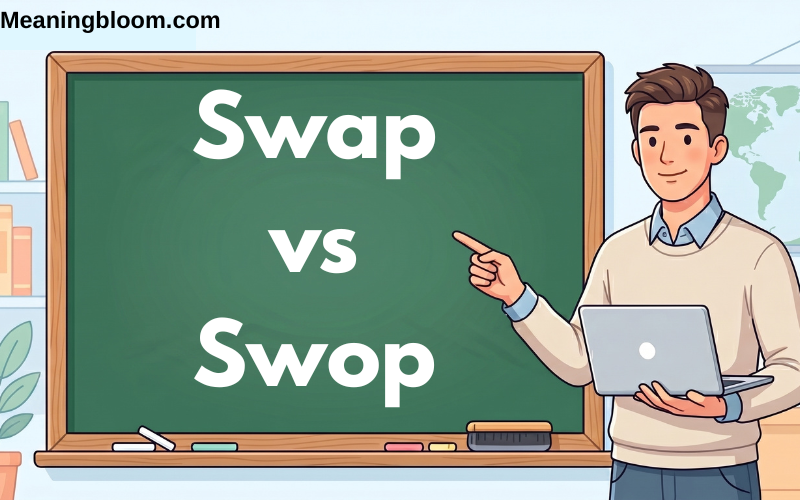

Swap vs Swop is a spelling debate that often catches writers off guard. Imagine you’re writing a sentence like, “We decided to swap books after class.” Everything looks correct. But then you come across the sentence, “We decided to swop books after class,” in an older British novel. Suddenly, you start wondering: are both spellings acceptable, or is one outdated?
The truth is that these two words share the same meaning—both refer to exchanging one thing for another—but their place in modern English is very different. For example, if a colleague says, “Let’s swap shifts next week,” the sentence sounds natural and current. However, replacing swap with swop can make the same sentence feel old-fashioned or unusual to today’s readers.
In this guide, we’ll break down the difference between swap vs swop, explore their historical roots, examine how dictionaries treat them today, and help you decide which spelling belongs in modern writing. By the end, you’ll know exactly which form to use with confidence.
What Do “Swap” and “Swop” Mean?
At their core, swap and swop mean exactly the same thing:
To exchange one thing for another.
They can be used as verbs or nouns.
As verbs:
- Let’s swap seats.
- They swopped books for the weekend.
As nouns:
- That was a fair swap.
- They agreed to a quick swop.
👉 Meaning-wise, there is no difference at all.
The confusion comes purely from spelling, usage, and time period — not from definition.
The Core Difference in Simple Terms
Here’s the short, practical answer most writers need:
- ✅ Swap = modern, standard, global spelling
- ⚠️ Swop = older British variant, now rare and outdated
Both are technically correct, but only one belongs in modern English writing.
The History Behind Swap and Swop
To really understand why both spellings exist, we need to look at how English evolved.
Old English Origins
The word traces back to Old English and early Germanic roots. A verb similar to swappan originally meant:
- to strike
- to move suddenly
- to exchange
Over time, the meaning shifted more strongly toward exchange or trade.
Middle English Development
By the Middle English period (1300–1500s), spellings were far from standardized. Writers spelled words the way they sounded.
Common forms included:
- swappe
- swape
- swap
Even Geoffrey Chaucer used early versions related to swap in his writing.
How “Swop” Appeared
During the 18th and 19th centuries, swop emerged as an alternative spelling, especially in parts of England where pronunciation leaned toward a shorter “o” sound.
This wasn’t unusual. English contains many spelling variations born from regional speech patterns.
Examples of similar evolution:
- shop / shope (older)
- drop / dropp (dialectal)
- stop / stopp (historic variants)
So swop was never a mistake — it was a reflection of spoken English at the time.
Modern Standardization
As dictionaries, printing, and education became more standardized, one spelling began to dominate.
By the early 20th century:
- swap became the preferred form
- swop began fading into obscurity
Swap vs Swop: Side‑by‑Side Comparison
| Feature | Swap | Swop |
| Meaning | Exchange or trade | Same meaning |
| Usage today | Very common | Rare |
| Tone | Neutral, modern | Old‑fashioned |
| Regional reach | Global | Mostly historical UK |
| Dictionary status | Standard | Variant / archaic |
| Recommended use | ✅ Yes | ⚠️ Avoid |
Bottom line: Swop isn’t wrong — it’s just no longer useful for modern communication.
Regional Usage: Where Each Word Appears
British English 🇬🇧
Historically, Britain is the only region where swop ever had noticeable traction.
You’ll still find it in:
- Classic children’s books
- Mid‑20th‑century novels
- Nostalgic or intentionally old‑fashioned writing
Example from older literature:
“We’ll swop secrets.”
However, modern British English has fully embraced swap.
Today:
- Newspapers use swap
- Broadcasters use swap
- Schools teach swap
Using swop in modern UK writing often feels dated or stylistic rather than natural.
American English 🇺🇸
In American English, the situation is simple:
👉 Swop essentially does not exist.
American dictionaries, publishers, and style guides recognize only swap.
Examples:
- They swapped jobs. ✅
- They swopped jobs. ❌
To American readers, swop usually looks like a typo.
Australian & New Zealand English 🇦🇺🇳🇿
These varieties once mirrored older British habits, but today they follow global standards.
- Swap is standard
- Swop is labeled archaic or obsolete
Modern writing in Australia and New Zealand overwhelmingly uses swap.
Other English‑Speaking Regions 🌍
In regions influenced by British education systems — such as:
- India
- Pakistan
- South Africa
- Nigeria
- Singapore
— English instruction emphasizes modern standardized spelling.
That means:
👉 Swap is taught, used, and expected.
Swop rarely appears outside historical texts.
Real‑Life Usage Examples

Let’s look at how these words appear in real contexts today.
| Context | Example | Preferred Form |
| Daily conversation | Let’s swap numbers. | Swap ✅ |
| Workplace | They swapped roles temporarily. | Swap ✅ |
| Technology | Users can swap accounts instantly. | Swap ✅ |
| Literature (old) | Let’s swop places. | Swop ⚠️ |
| Historical fiction | They swopped horses. | Swop ⚠️ |
Notice a pattern?
Modern life runs on swap.
What Dictionaries Say About Swap vs Swop
Oxford English Dictionary
- Swap: Standard modern form
- Swop: British variant, now rare
Cambridge Dictionary
- Swap: Common in UK and US
- Swop: Old‑fashioned spelling
Merriam‑Webster (US)
- Lists swap only
- Does not recognize swop
Collins English Dictionary
- Includes both
- Marks swop as informal or dated
Dictionary verdict: Use swap for clarity and correctness.
Style Guide Recommendations
Professional writers rely on style guides for consistency.
| Style Guide | Recommendation |
| Oxford Style Manual | Use swap |
| Guardian Style Guide | Avoid swop |
| Chicago Manual of Style | Swap only |
| AP Stylebook | Swap standard |
👉 Editorial consensus is crystal clear.
Common Phrases That Use “Swap”
Another reason swap dominates is how deeply it’s embedded in modern expressions.
Popular phrases include:
- Swap places – Let’s swap places.
- Swap stories – We swapped stories.
- Swap out – Swap out the old part.
- Swap meet – a flea market
- Data swap – technology term
There are no modern equivalents using swop.
This makes swap far more productive and flexible.
Why Using “Swop” Today Can Be Risky
Even though swop isn’t technically wrong, it can cause problems:
1. Reader Confusion
Many readers — especially non‑native speakers — assume it’s a spelling error.
2. Professional Credibility
Outdated spelling can make writing look careless or poorly edited.
3. SEO & Digital Content
Search engines overwhelmingly recognize swap.
Using swop may:
- Reduce keyword relevance
- Lower search visibility
- Confuse algorithms and readers
4. International Audiences
Global readers expect modern standard English.
👉 Swap builds trust. Swop raises eyebrows.
Swap vs Swop in SEO and Online Writing

If you write blogs, articles, or marketing content, spelling matters.
Why swap is better for SEO:
- Higher search volume
- Recognized by autocomplete
- Matches user intent
- Preferred by grammar tools
Swop, by contrast:
- Has negligible search traffic
- May be flagged as an error
- Weakens keyword consistency
SEO rule of thumb: Always optimize for swap.
When (If Ever) Should You Use “Swop”?
There are only a few valid scenarios:
- Quoting an older British text
- Writing historical fiction
- Preserving an author’s original wording
- Creating a deliberately old‑fashioned tone
Outside these cases, avoid it.
Final Decision Guide
| Situation | Best Choice |
| Everyday writing | Swap |
| Business content | Swap |
| Academic work | Swap |
| International audience | Swap |
| Historical quotation | Swop (only if original) |
If you’re unsure — choose swap. You’ll never be wrong.
FAQs
Is “swop” a real word in English?
Yes, swop is a real English word and has been used historically in British English. However, it is now considered rare and outdated, while swap has become the standard spelling worldwide.
Why is “swap” more common than “swop”?
Over time, dictionaries, publishers, and educational institutions adopted swap as the preferred spelling. As a result, it became the dominant form in modern English, while swop gradually fell out of regular use.
Can I use “swop” in modern writing?
You can, but it is generally not recommended. Most readers expect swap, and using swop may make your writing appear old-fashioned or create unnecessary confusion.
Is there a difference in pronunciation between swap and swop?
No. Both words are usually pronounced in a very similar way, which is one reason many people assume they are interchangeable. The distinction is mainly in spelling and usage rather than pronunciation.
Which spelling should I use in academic or professional writing?
Always use swap. For example, “The departments agreed to swap resources for the project” follows modern writing standards and looks professional in any formal context.
Do British dictionaries still include “swop”?
Some British dictionaries still list swop as a variant spelling, but they typically label it as old-fashioned, uncommon, or dated. Swap remains the preferred choice.
Is “swop” accepted in Scrabble and word games?
Yes, many official word-game dictionaries still recognize swop as a valid word. However, its acceptance in word games does not mean it is commonly used in everyday English.
What is the easiest way to remember the correct spelling?
A simple rule is: if you’re writing for a modern audience, choose swap. Whether you’re swapping seats, swapping ideas, or swapping products, swap is almost always the correct spelling to use today.
Conclusion
When comparing swap vs swop, the meaning remains the same, but modern usage tells a different story. Both words describe an exchange, whether you’re swapping phone numbers, trading seats, or exchanging ideas. For example, “The two friends swapped jackets for the day” sounds perfectly natural in contemporary English. Writing “The two friends swopped jackets for the day” may still be understood, but it feels dated and uncommon.
Over time, English spelling standards have overwhelmingly favored swap, making it the preferred choice in schools, businesses, media, and online communication. While swop survives in some historical texts and older British writing, it has largely disappeared from everyday use.
If your goal is clear, professional, and reader-friendly writing, the safest choice is always swap. It’s the spelling recognized worldwide, trusted by editors, and expected by modern audiences. Simply put, swop belongs to English history, while swap belongs to modern English.